
Most beginners don’t struggle because they lack talent. They struggle because the hiring market doesn’t work the way universities, bootcamps, and YouTube tutorials describe it. You’re told to “learn more” while recruiters quietly filter out candidates who can’t show proof of ability. Beginners who follow a structured career roadmap for software engineer often avoid this trap
Here’s the uncomfortable reality: “No experience” rarely means zero proof of skill.
Companies still expect signals that you can solve problems, write clean code, and work with tools used in real teams.
This article walks through what employers really look for, why applications fail, and how to position yourself as a credible junior candidate. This requires understanding the core competencies employers prioritize.
The Brutal Truth About “No Experience” Jobs
Many listings say entry level or no experience required. Yet hiring managers still screen for evidence of competence. That evidence doesn’t have to be paid work, but it must exist. Academic learning paths or bootcamp training alone rarely satisfy this expectation.
No internships, no projects, no GitHub activity rejection is predictable.
Recruiters are not evaluating potential. They are evaluating risk. A candidate without proof of execution looks risky compared to someone who has built real projects.
This connects directly to why most beginner applications fail.
Why Most Beginner Applications Get Rejected
The rejection rarely happens because of intelligence. It happens because of presentation and positioning.
Common failure points:
- ATS filters remove resumes lacking keywords
- Resumes list skills without proof
- Portfolios show tutorial clones
- GitHub repos look inactive
- Projects lack depth or explanation
A hiring manager scanning 200 resumes will prioritize candidates who demonstrate applied skills. Not claims. Not certificates. Many of these failures originate from weak project presentation rather than lack of skill.
Which leads to the next critical question.
What Hiring Managers Actually Look For
Forget motivational advice. Here’s what repeatedly matters in early-career screening:
| Signal | What It Tells Employers |
|---|---|
| Projects with real functionality | You can build something usable |
| Clean, readable code | You understand structure |
| GitHub activity | You practice consistently |
| Problem-solving examples | You think logically |
| Resume clarity | You communicate effectively |
Candidates with clarity on industry expectations align their efforts more effectively. Course completion does not equal job readiness.
This naturally raises another confusion beginners face.
Skills That Matter for Your First Role
Beginners often try to “learn everything.” That approach delays hiring and increases burnout.
Focus on market-relevant fundamentals instead:
- One core programming language (JavaScript, Python, Java, etc.)
- Basic data structures and logic
- Version control (Git)
- Framework familiarity (React, Node, Django, etc.)
- Debugging ability
- Understanding APIs
Depth beats breadth. A focused learning path accelerates employability far more than scattered study.
A candidate who understands one stack well is more convincing than someone who lists ten technologies superficially.
But skills alone aren’t enough without proof.
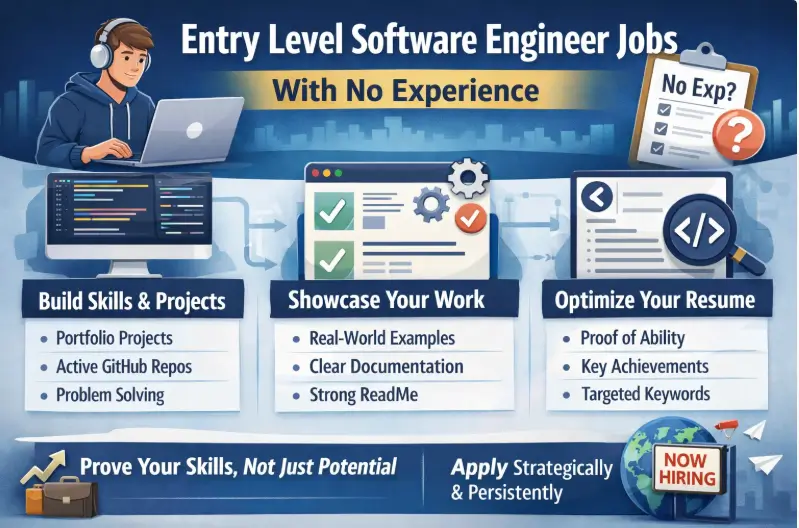
How to Build “Experience” Without a Job
Employers accept non-paid experience if it resembles real-world work. Designing a strong portfolio strategy ensures projects signal real capability.
Strong beginner portfolio ideas:
- CRUD web application with authentication
- API-integrated dashboard
- Small SaaS-style tool
- Automation scripts solving practical problems
- Bug fixes or contributions to open source
Weak examples:
- Tutorial copies
- “Calculator app” clones
- Projects without documentation
A good project shows decisions, not just features.
Explain:
- Why you built it
- What problem it solves
- Challenges faced
- Improvements made
That explanation feeds directly into resume strength.
Resume Strategies for Candidates With No Experience
An empty resume is not your problem. A poorly framed resume is.
Instead of:
“Skills: JavaScript, React, Node”
Use:
“Built a task management app using React and Node.js with user authentication and REST API integration”
Replace “education-only resumes” with “proof-of-work resumes.” This shift is critical for candidates pursuing alternative backgrounds.
Include:
- Key projects
- Technologies used
- Achievements (performance, features, users)
- GitHub links
- Portfolio links
Recruiters scan for evidence, not effort.
Which brings us to competition.
How to Stand Out Against Candidates With Experience
You’re competing with graduates who have internships. You can’t change that, but you can change positioning.
Effective differentiation:
- Niche specialization (e.g., frontend performance, APIs, testing)
- Polished GitHub repositories
- Strong README documentation
- Demonstrated consistency
- Realistic project complexity
Most junior candidates look identical. Same stacks. Same tutorials. Same vague resumes.
Distinctiveness increases interview probability. A realistic career timeline helps beginners benchmark progress correctly.
Now let’s talk about job discovery.
Where to Find Legit Entry Level Software Engineer Jobs
Avoid relying on one platform. Each source attracts different employers.
High-value channels:
- Indeed
- LinkedIn Jobs
- ZipRecruiter
- Company career pages
- Startup job boards
- Niche tech communities
Use smarter search queries:
- “junior software engineer”
- “graduate software engineer”
- “associate software developer”
- “software engineer I”
“No experience” is often implied, not stated.
This is especially important for remote roles.
Remote Entry Level Jobs: Reality vs Expectation
Remote beginner roles exist but competition is extreme.
What companies expect remotely:
- Strong communication
- Self-management
- Clear technical competence
- Production-level code quality
Beginners underestimate this. Remote hiring managers can choose from global talent pools. Strong foundations in testing fundamentals also improve remote readiness.
A weak portfolio is fatal in remote screening.
Which often ties back to salary expectations.
Entry Level Software Engineer Salary: What’s Realistic
Compensation varies by region, stack, and company type.
Factors influencing pay:
- Country / city
- Technology demand
- Company size
- Internship background
- Negotiation skill
Early-career salary growth is steep once experience begins.
First job = credibility multiplier.
Second job = income acceleration.
Obsession with starting salary often distracts from the more urgent goal: getting hired.
Myths That Keep Beginners Stuck
Myth 1: “I must master everything first”
Reality: Hiring happens with competence, not perfection.
Myth 2: “Certificates guarantee interviews”
Reality: Projects and proof dominate. Candidates from nontraditional paths often overestimate certificate value.
Myth 3: “Entry level means easy”
Reality: Junior hiring is highly competitive.
Myth 4: “Rejection means I’m not good enough”
Reality: Often positioning, not ability.
These misconceptions delay progress more than technical gaps.
A Practical Action Plan
If you currently have no experience:
- Select one primary tech stack
- Build 2–4 meaningful projects
- Clean and structure GitHub
- Rewrite resume around proof
- Practice interviews strategically
- Apply consistently with targeting
Avoid endless tutorial consumption. Learning without output produces confidence illusions, not job offers. Following a defined progress framework prevents burnout and confusion.
Execution builds credibility.
Credibility drives interviews.
FAQs about software engineer jobs with no experience
1. Is it truly possible to get a software engineer job with no experience?
Yes, but “no experience” still requires proof of skill. Employers accept projects, GitHub activity, internships, freelance work, or open-source contributions. The absence of paid experience isn’t the blocker. The absence of demonstrable ability is.
2. What if every job posting asks for 1–2 years of experience?
Treat experience requirements as guidelines, not absolute barriers. Many companies hire candidates who meet 60–70% of expectations. If you have relevant projects, practical skills, and a strong resume, apply. Self-elimination kills more opportunities than rejection.
3. Do I need a computer science degree to get hired?
A degree helps but is not mandatory. Hiring managers prioritize problem-solving skills, coding ability, and project quality. Strong portfolios frequently outweigh formal credentials, especially in startups, mid-size companies, and skill-focused hiring environments.
4. What matters more: certificates or projects?
Projects. Certificates validate learning; projects validate capability. A recruiter gains little insight from course completion alone. A working application, clean codebase, and thoughtful documentation provide tangible evidence you can build and ship solutions.
5. How many projects should I build before applying?
Quality beats quantity. Two to four solid projects demonstrating real functionality, clear structure, and practical problem-solving are sufficient. Avoid shallow clones. Depth, usability, and code clarity influence screening decisions far more than project count.
6. Why am I not getting interview calls?
Most often: resume positioning, weak project presentation, ATS keyword gaps, or generic portfolios. Review how your skills are framed. Replace vague skill lists with measurable outputs. Align keywords with job descriptions. Ensure GitHub repositories look active and credible.
7. Am I too late to start at 25 (or older)?
No. Age is rarely a hiring constraint. Skill relevance and proof of ability dominate decisions. Many developers enter the field after career changes. Focus on competence, portfolio strength, and interview preparation rather than timeline anxiety.
Conclusion
Breaking into software engineering without formal experience is challenging but entirely achievable with the right strategy. The decisive factor isn’t years worked it’s evidence of capability. Strong projects, a focused skill set, clear resume positioning, and realistic expectations dramatically improve hiring outcomes. Instead of chasing endless tutorials or certifications, prioritize execution and demonstrable results. Employers hire candidates who reduce perceived risk. A deliberate skill development plan combined with proof-driven projects remains the most reliable path forward.