
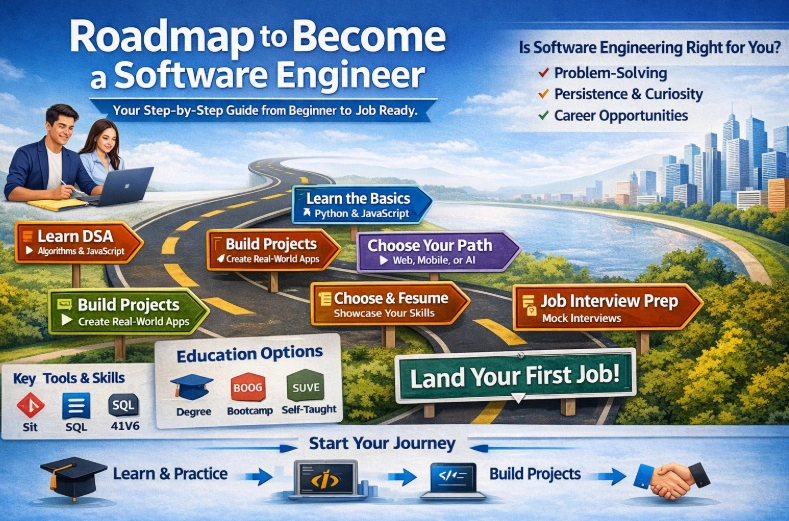
Becoming a software engineer can feel overwhelming. There are hundreds of skills, paths, and tools to choose from. This guide breaks it all down into a clear, step-by-step roadmap to become a software engineer, so you know exactly what to learn, in what order, and how to land your first job.
This guide is for:
- Beginners who want to start coding from scratch.
- Career switchers moving into tech.
- Non-CS graduates who want to build real skills.
By the end, you’ll have a clear 12-month roadmap, projects to showcase, and the confidence to apply for your first software engineer role.
1. Is Software Engineering Right for You?
Before you start, it’s important to ask: Do I really want this career?
Skills & Mindset You Need
- Problem-solving: Can you break problems into steps?
- Persistence: Coding is full of trial and error.
- Curiosity: You need to keep learning new tools and technologies.
Common Fears & Misconceptions
- “I’m too late to start coding.” → It’s never too late. Many engineers started in their 20s or 30s.
- “It’s too hard.” → Hard, yes. Impossible, no. Focused practice beats natural talent.
Career Prospects & Earning Potential
- Junior developers in the US start at $70k–$90k/year; senior roles can exceed $150k.
- Remote work opportunities allow you to work for companies worldwide.
2. Understanding the Software Engineer Career Path
There’s more than one way to become a software engineer.
Education Paths
- CS Degree – Traditional, widely recognized, but expensive and slower.
- Bootcamps – Fast, intensive, project-focused. Great if you need structure.
- Self-Taught – Flexible, free or low-cost, requires discipline.
Roles & Specializations
- Web Development – Frontend (React, Vue) or Backend (Node.js, Django)
- Mobile Development – iOS (Swift) or Android (Kotlin)
- AI / Machine Learning – Python, TensorFlow, data analysis
- DevOps / Cloud – AWS, Docker, CI/CD pipelines
To deploy your apps in the cloud, refer to enterprise software and cloud tools to get started with AWS and Docker
Timeline Reality (Objection keyword: how long does it take?)
- Average to become job-ready: 6–12 months of focused learning and projects.
3. Core Technical Skills You Must Learn
Programming Languages
- Python: Beginner-friendly, versatile
- JavaScript: Essential for web development
- Java: Widely used in enterprise apps
You’ll start with Python and JavaScript—check out tools for engineering projects that will help you practice effectively
Data Structures & Algorithms (DSA)
- Learn arrays, lists, stacks, queues, trees, and graphs
- Practice sorting and searching algorithms
Version Control
- Git & GitHub: Track code changes, collaborate with others
Practice Platforms
- LeetCode, HackerRank, Codewars: Sharpen problem-solving skills
Example:
Build a simple calculator app in Python and push it to GitHub to track your learning progress.
4. Building Projects & a Portfolio
A portfolio is your ticket to landing a job.
Types of Projects
- Mini-projects: Calculator, Todo App, Personal Website
- Capstone project: Web app, mobile app, or small AI project
How to Showcase
- Use GitHub to store code
- Write a short description of what you built and the problem it solves
- Include screenshots or demo links
Real Example:
- Project: “Budget Tracker App” – Tracks income & expenses, built using Python + Flask, deployed on Heroku.
- “Use collaborative tools to showcase your work, like those in 8tshare6a software
5. Tools, Concepts & Advanced Skills
Essential Tools
- IDEs: VS Code, PyCharm
- Testing: Unit testing with pytest or Jest
- Debugging: Learn to read stack traces and fix bugs
Learn how to set up your IDEs using guides like essential software tools
Cloud & DevOps Basics
- AWS: Host apps in the cloud
- Docker: Containerize apps
- CI/CD: Automate testing & deployment
System Design Overview
- Understand how apps scale
- Learn about databases, caching, and APIs
6. Soft Skills & Job Preparation
Communication & Teamwork
- Code reviews: Give & receive feedback
- Collaboration tools: Slack, Jira, Trello
Networking
- LinkedIn: Connect with other engineers
- GitHub contributions: Shows activity to recruiters
Build your professional presence by sharing projects on platforms for sharing your work and collaborating
Resume & Interview Prep
- Tailor your resume for each role
- Practice coding interviews with mock questions
Decision Point:
You’re ready to apply for jobs when you can:
- Solve basic coding problems confidently
- Build and explain 2–3 projects
- Discuss tools, languages, and concepts clearly
7. Specialization & Career Growth
- Choosing a Stack: Decide based on job demand, interest, and time to learn
- Advanced Skills: System design, architecture, performance optimization
- Career Progression: Junior → Mid → Senior → Lead Engineer
Pros & Cons Example:
| Specialization | Pros | Cons |
|---|---|---|
| Web Development | High demand, lots of tutorials | Highly competitive |
| Mobile Development | Growing market, creative | Limited job roles |
| AI / ML | Cutting-edge, high salary | Steep learning curve |
| DevOps / Cloud | Stable demand, global | Requires broad skill set |
8. Actionable 12-Month Step-by-Step Plan
| Month | Focus | Key Action |
|---|---|---|
| 1–3 | Basics & Programming | Python, JS, Git, small exercises |
| 4–6 | DSA & Projects | Data structures, 2 mini-projects, GitHub portfolio |
| 7–9 | Specialization & Tools | Pick stack, build capstone project, learn cloud basics |
| 10–12 | Job Prep | Resume, LinkedIn, interview prep, apply to jobs |
Milestones:
- Month 3: Can build small apps
- Month 6: Portfolio ready
- Month 9: Specialization mastered
- Month 12: Ready for interviews
Tip: Track your progress weekly; adjust based on speed and comfort.
FAQs
1. How long to become a software engineer?
With focused learning, coding practice, and real projects, most beginners can become job-ready in 6–12 months. The exact timeline depends on your pace, prior experience, and consistency. Progress is measured by skills, portfolio, and interview readiness, not just months spent.
2. Is it too late to start coding?
No. People start coding at any age. Many successful software engineers began in their 20s, 30s, or even later. What matters is consistent practice, structured learning, and building projects that show your abilities to employers.
3. How many hours do software engineers work?
Typical full-time software engineers work 40–45 hours per week, with some flexibility for remote work. Startups or project deadlines may require extra hours temporarily, but most companies value work-life balance and output over strict time spent coding.
4. How to decide between degree, bootcamp, or self-taught?
Degree: Strong foundation, slower, expensive
Bootcamp: Fast, project-focused, structured
Self-taught: Flexible, free, requires discipline
Choose based on budget, timeline, learning style, and career goals. All paths can lead to a software engineer job if you build skills and a portfolio.
5. Can you make $500,000 as a software engineer?
Yes, but it’s rare and usually for senior engineers, specialized roles, or high-demand tech sectors like AI, cloud, or leadership positions. Most start lower, but with skill growth, specialization, and experience, your earning potential can increase significantly.
What is the 80/20 rule in software engineering?
The 80/20 rule means 80% of results come from 20% of your work. Focus on high-impact skills, core concepts, and key projects. Don’t waste time on less relevant topics; mastering the essentials accelerates your path to becoming a competent engineer.
7. What is the 40/20/40 rule in software engineering?
The 40/20/40 rule suggests dividing your focus: 40% learning fundamentals, 20% building projects, 40% practical application & practice. This ensures balanced growth in knowledge, hands-on experience, and real-world problem-solving skills, which employers value most.
Conclusion: Roadmap to Become a Software Engineer
This roadmap covers everything you need to go from zero to a job-ready software engineer in 6–12 months.
- Clear skills + projects + tools
- Step-by-step timeline + milestones
- Realistic view of career paths & obstacles
- Portfolio & soft skills integrated
By following this roadmap and tracking your progress, you’ll save time, avoid confusion, and gain confidence.