
Choosing the right path to become a software engineer is confusing and stressful. Each option a computer science degree, a coding bootcamp, or self-teaching has different costs, timelines, and career outcomes. Understanding these factors helps you make the best decision for your situation. In this guide, we break down each path, compare real costs and salaries, and show what works in the real world.
What a Computer Science Degree Offers
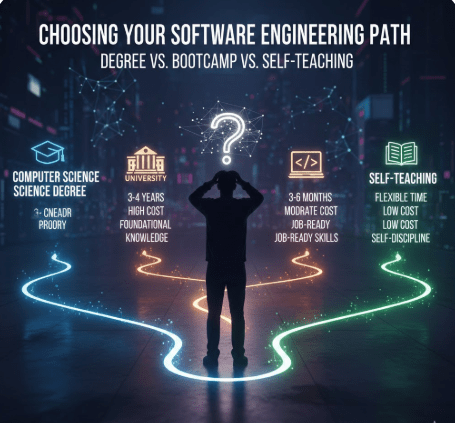
A computer science degree typically takes three to four years to complete. The cost can be significant, especially in the US, where tuition alone may reach $40,000 per year. Degrees teach foundational concepts like algorithms, data structures, and systems design, which prepare you for a wide range of tech roles. Graduates often get stable jobs in large companies, but the time and money investment is much higher compared to other paths.
Coding Bootcamps: Fast-Track to a Job
Coding bootcamps are short, intensive programs usually lasting three to six months. They focus on practical skills and portfolio projects rather than theory. The cost ranges from $7,000 to $20,000, often with financing or income-share agreements. Bootcamps excel at job placement for junior roles, but success depends heavily on motivation, networking, and personal effort, as the program alone cannot guarantee employment. Directs readers who want explore coding bootcamp to a structured learning roadmap.
The Self-Taught Route
Self-teaching requires discipline, planning, and persistence. Costs are usually low, often under $1,000, using online courses, books, and tutorials. Time to job readiness varies from six months to several years, depending on how many hours you dedicate weekly. Success relies on building a portfolio, contributing to open-source projects, and connecting with the developer community. Employers value proven skills over credentials, but this path is the least structured. Supports readers building portfolio projects and learn software testing skills.
Comparing Costs Across Paths
A computer science degree has the highest upfront cost, often exceeding $100,000 when including living expenses. Bootcamps have moderate fees, ranging from $7,000 to $20,000, while self-teaching is almost free, aside from minor tools or courses. Opportunity cost also matters: a degree requires years out of the workforce, whereas bootcamps and self-teaching allow faster entry. Comparing total investment versus potential salary is crucial before choosing. Learn more about computer science degrees on Wikipedia.
Time to Job: Realistic Expectations
Degree programs generally take three to four years, while bootcamps take three to six months, and self-taught learners vary widely based on effort. Degrees provide a structured environment, but time to employment is longer. Bootcamps accelerate learning, often including career support, while self-taught paths are highly flexible but require self-discipline and project completion. Understanding your timeline is essential for planning a career switch. Companies like Microsoft, Google, and Apple often hire developers based on skills and portfolio, not just formal degrees. Exploring their career pages can show you exactly what skills and experience they value.
ROI and Career Growth
Return on investment differs significantly. Degree holders may earn higher starting salaries, around $65,000–$80,000 in the US, with strong long-term growth. Bootcamp graduates earn $50,000–$70,000 initially, but growth depends on continuous learning and networking. Self-taught developers can reach comparable salaries if they demonstrate skills through projects and freelance or open-source experience. ROI depends on speed, cost, and career ambition.
Job Market Reality
Employers often care more about skills than degrees, especially in startups. Large tech companies still favor CS degrees for senior roles, but bootcamps and self-taught candidates have broken into these companies with strong portfolios. Networking, GitHub contributions, and real-world projects can level the playing field. Understanding where each path is valued helps avoid wasted effort and ensures your investment in learning translates into employment. Helps readers understand software engineering career roadmap and required skills.
Personal Experience: Choosing a Path
Many developers start with bootcamps for quick entry and later supplement with self-teaching for advanced skills. Some complete degrees for credibility and stability, especially if targeting FAANG or enterprise jobs. Self-taught learners often thrive when driven by curiosity and able to navigate independent learning. Real-world experience shows that combining methods often produces the best outcomes in skill mastery and career advancement.
Practical Tips for Each Path
For a CS degree, focus on internships and networking while studying to reduce the opportunity cost. Bootcamp students should complete projects, contribute to GitHub, and attend meetups to stand out. Self-taught learners must plan a curriculum, practice consistently, and create a portfolio that demonstrates problem-solving skills. Each path requires strategic planning, but awareness of these practical steps ensures maximum ROI and faster career progression. Encourages hands-on practice for self-taught or bootcamp learners. Encourages hands-on practice with circuit simulation tools for self-taught or bootcamp learners.
How to Decide What’s Best for You
Start by evaluating budget, timeline, and career goals. If you need structured learning and credentials, a CS degree is ideal. If you want speed and practical skills, bootcamps are effective. If you are self-motivated and resourceful, self-teaching can work. Consider long-term growth, stability, and salary expectations, then choose a path that aligns with your learning style and personal situation.
Combining Paths for Maximum Advantage
Some developers mix approaches: a degree for credibility, bootcamps for practical skills, and self-learning for continuous improvement. This combination accelerates learning, strengthens portfolios, and reduces risk. Many success stories show that continuous learning and adaptation matter more than the initial choice alone. Strategic integration ensures you gain theory, practice, and real-world application, boosting both skills and employability. Even those pursuing a degree or bootcamp can benefit from hands-on practice with professional applications, including the JPro Software Truck Diagnostic Tool, to accelerate learning and show practical competence
Faqs
Are bootcamps better than a degree?
Bootcamps are better if you need a job fast and can study full-time. Degrees are better if you want long-term safety and more job options. Neither is superior. The right choice depends on your time, money, and career goals.
Is 27 too late to start coding?
No. 27 is early, not late. Many developers start in their 30s and 40s. What matters is daily practice and real projects. Age does not block hiring. Weak skills and no portfolio do.
Is it worth getting a CS degree anymore?
No. 27 is early, not late. Many developers start in their 30s and 40s. What matters is daily practice and real projects. Age does not block hiring. Weak skills and no portfolio do.
Is a bootcamp worth it in 2026?
Yes, if it teaches real skills and has strong job support. Bootcamps fail when students expect magic. If you treat it like a full-time job and build real projects, a good bootcamp can still pay off fast.
What 2-year degree makes the most money?
An associate degree in computer science or software development often leads to high-paying entry-level jobs, especially in web development, data analysis, or IT support, providing strong ROI and fast time to job compared to longer programs.
What is the hardest degree to go on?
Engineering, computer science, and medicine are typically the most challenging, requiring intense study, projects, and problem-solving skills. Focus, discipline, and strategic learning make them manageable, and they offer strong long-term career growth and salary potential.
Do employers respect bootcamps?
Yes, many employers value coding bootcamp graduates who show practical skills, portfolio projects, and problem-solving ability. While large tech firms may prefer degrees for senior roles, bootcamps offer fast-track entry and excellent ROI for career switchers.
Was Elon Musk a coder?
Yes. Elon Musk started coding at a young age and built software independently. His path shows that self-taught developers can succeed without formal degrees when skills, persistence, and portfolio projects are strong.
Will AI replace coding jobs?
AI can automate repetitive coding tasks but cannot replace creative problem-solving, architecture design, or human-led projects. Self-taught developers, bootcamp graduates, and degree holders who focus on real-world experience will remain in demand.
Conclusion
Choosing between a computer science degree, coding bootcamp, or self-taught path depends on your goals, budget, and timeline. A degree provides long-term stability, a bootcamp accelerates learning with practical skills, and self-teaching rewards discipline and portfolio projects. Understanding the time to job, ROI, and job market reality helps career switchers make data-driven decisions that maximize growth and secure real-world opportunities effectively.
I like how this breaks down not just the timelines, but the ROI and job market realities of each path—those tradeoffs are often glossed over. One thing I’d add is that combining paths (like self-teaching alongside a degree or bootcamp) seems to matter more than the label itself, especially when employers care most about real projects and problem-solving skills. The emphasis on practical experience really reflects what’s happening in hiring right now.